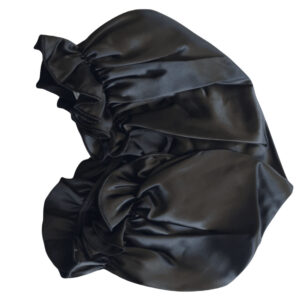

You spend time and money caring for your hair during the day. But what happens while you sleep could be undoing all of that effort. Cotton pillowcases create friction as you toss and turn, absorb moisture from your strands, and leave hair rough, tangled, and prone to breakage by morning. A silk bonnet addresses all of this in one simple step.
Whether you have straight, curly, or chemically treated hair, this guide answers the most common questions about silk bonnets so you can decide whether one belongs in your nighttime routine.
Are Silk Bonnets Good for Your Hair?
Yes. The core benefit of a silk bonnet comes down to two things: friction reduction and moisture retention. Cotton, which most people sleep on, has a rough fibre surface that grips hair as you move in your sleep. Over time, this friction causes the hair cuticle to lift, leading to frizz, split ends, tangles, and breakage.
Silk has an exceptionally smooth surface. When your hair rests against it, there is far less resistance, which means the cuticle stays flat and intact. Flat cuticles reflect light better, which is why silk sleepers often notice their hair looks shinier in the morning.
The second benefit is that silk is far less absorbent than cotton. Cotton wicks moisture from your hair and from any products you have applied, such as leave-in conditioners, oils, or serums. Silk leaves those products in your hair where they belong, keeping strands hydrated overnight.
A bonnet offers an additional advantage over a silk pillowcase in that it fully encloses the hair, so it stays protected regardless of how much you move during the night. Your hair cannot slip off a bonnet the way it can slide off a pillow.
Are Silk Bonnets Good for Straight Hair?
Yes, and straight hair types are often the ones most likely to underestimate the benefit. Straight hair lies flat against a pillow all night, which means every strand is in constant contact with the pillowcase surface. The friction this creates is the primary cause of morning frizz, flyaways, and the roughness that makes hair harder to style.
If you blow-dry or straighten your hair, a silk bonnet helps preserve that finish overnight. Without one, even a single night on cotton can disrupt a blow-out and create the kind of frizz and volume at the roots that requires restyling. With a bonnet, the style is far more likely to survive intact until morning.
Straight hair also benefits from the moisture retention aspect, particularly if it is fine, highlighted, or colour-treated, since those hair types tend to be drier and more fragile.
Are Silk Bonnets Good for Curly Hair?
Curly and coily hair types benefit more from a silk bonnet than any other hair type. This is because the structure of a curl or coil means the hair cuticle is naturally more raised and prone to tangling. Cotton pillowcases make this significantly worse by snagging individual strands and disrupting the curl pattern as you sleep.
Silk bonnets are a staple in curly hair care for several reasons. They preserve curl definition overnight, which means less time refreshing or re-styling in the morning. They retain the moisture that curly hair constantly needs, since this hair type is more prone to dryness due to the way natural oils travel down a curved strand. They also keep braids, twists, and protective styles neat, which extends the life of those styles considerably.
For anyone following a curly girl or curl-focused routine, a silk bonnet is one of the most effective and low-cost investments in the routine.
Are Silk Bonnets Worth It?
Yes, particularly when you consider what a silk bonnet is protecting. Hair that breaks overnight has to regrow. Split ends have to be cut. Styles that get destroyed have to be redone. The cumulative damage that cotton pillowcases cause over months and years is real, and it shows up as shorter length retention, chronic dryness, and hair that never seems to get past a certain length despite regular care.
A silk bonnet is a one-time purchase that, if cared for properly, will last for years. Compared to the cost of salon treatments, deep conditioning products, and the time spent restyling, it is one of the better value items in a hair care routine.
That said, not all silk bonnets are equal. The grade and momme weight of the silk matters. A higher momme weight, such as 22 momme, indicates a denser, more durable weave that will hold up to nightly use and washing without degrading quickly. Lower-quality bonnets, especially those made from polyester satin that is marketed as silk, will not deliver the same results and will not last as long.
Are Silk Bonnets Better Than Satin?
This depends on what is meant by satin. Satin is not a material, it is a weave pattern. Most products sold as satin bonnets are made from polyester with a satin weave, not from silk.
True silk outperforms polyester satin on every relevant measure for hair care. Silk is a natural protein fibre with a naturally smooth surface and a lower friction coefficient than synthetic polyester. It is also breathable, which means less heat builds up under the bonnet overnight, and naturally hypoallergenic, which matters for people with sensitive skin or scalps.
Polyester satin can still be better than cotton, because the weave pattern does create a smoother surface than standard cotton. However, it does not breathe as well, is not as smooth as genuine silk, and does not have the same moisture-balancing properties.
If you are comparing a real silk bonnet to a polyester satin bonnet, silk is the better choice for hair protection. If you are comparing a silk bonnet to a silk pillowcase, both are made from the same material and the choice comes down to personal preference and sleeping habits. The bonnet keeps hair fully enclosed and protected all night, while the pillowcase requires no preparation but cannot guarantee the same consistent contact.
Are Silk Bonnets Good for All Hair Types?
Yes. While curly and coily hair types tend to see the most dramatic improvement, the benefits of reduced friction and retained moisture apply to every hair type. Fine hair, which is prone to breakage, benefits from the gentleness of silk. Thick hair, which tangles easily, benefits from the smooth surface reducing knots. Chemically treated, coloured, or heat-styled hair benefits from the protection against mechanical damage that could accelerate breakage along weakened strands.
Even if your hair is healthy, strong, and naturally resilient, there is no downside to reducing friction and retaining moisture while you sleep. The difference may be less dramatic for someone with very healthy, coarse hair, but it is still a net positive for the hair.
Your Questions Answered
Can I wear a silk bonnet with wet hair?
It is not recommended. Wet hair is at its most fragile and vulnerable to breakage. The weight of water causes the hair shaft to swell, which weakens the bonds within the strand and makes it far more susceptible to damage from any friction or tension. Wearing a bonnet on wet hair also traps moisture against the scalp for an extended period overnight, which can create conditions that encourage scalp issues. It is better to allow hair to dry fully, or at least mostly, before putting on a bonnet.
Can silk bonnets cause hair loss?
A properly fitted silk bonnet should not cause hair loss. However, any bonnet with an elastic band that is too tight can cause traction alopecia over time, which is hair loss resulting from tension on the follicles at the hairline. This is not a problem specific to silk bonnets but to ill-fitting headwear in general. A silk bonnet should sit comfortably on the head without pulling at the edges. If you find the elastic leaves marks on your forehead or feels tight, it is worth looking for a looser option.
Can a silk bonnet help with hair loss?
A silk bonnet can reduce hair loss that is caused by mechanical damage, such as breakage from friction, tangling, and rough handling during sleep. This type of hair loss, where strands snap mid-shaft rather than falling from the root, is very common and a silk bonnet directly addresses it. However, hair loss caused by medical conditions, hormonal changes, nutritional deficiencies, or genetic factors is a different matter entirely. A silk bonnet is not a treatment for those conditions and should not be positioned as one.
Do silk bonnets work?
Yes. The mechanism is straightforward and supported by what we know about hair structure. Hair cuticles are damaged by friction, heat, and moisture loss. Silk reduces friction and slows moisture loss while remaining cool and breathable. People who switch from cotton pillowcases or nothing at all to a silk bonnet consistently report less breakage, less frizz, better moisture retention, and better preservation of styles overnight. The results are more noticeable for hair types that are already drier or more fragile, but the protection is real across all hair types.
Do silk bonnets help hair?
Yes. The primary ways a silk bonnet helps hair are by reducing the mechanical damage caused by friction during sleep, retaining natural oils and applied products in the hair rather than allowing them to be absorbed into bedding, and keeping styles, particularly curl patterns and protective styles, intact overnight. Over time, reduced nightly damage contributes to less breakage, better length retention, and healthier-looking hair overall.
Do silk bonnets help with greasy hair?
Not directly. Greasy hair is caused by sebum production at the scalp, and a silk bonnet does not influence how much oil your scalp produces. Where silk does make a difference compared to cotton is that it does not absorb the oils from your hair and scalp the way cotton does, which means your natural oils stay on your hair and scalp rather than transferring to your pillowcase. For someone who already finds their hair gets oily quickly, this aspect of silk is unlikely to be a selling point. For someone whose hair tends toward dryness, it is a benefit.