
Buy a “standard” pillowcase in Johannesburg, London, Sydney, New York and Berlin and you will come home with five different sizes. One of them will not even be rectangular. For something as universal as a pillow, that seems strange. Everyone has a head, most of us sleep lying down, and beds around the world are broadly similar. So why is there no single standard pillow size?
The short answer is that there never was one. “Standard” simply means the size most commonly sold in a particular market. It is a retail convention, not an international specification. The longer answer takes us through German feather-plucking evenings, French reading pillows, the switch from inches to centimetres, and the way bedding sets quietly lock old habits in place.
There is no international pillow standard
Mattresses, duvets and pillows have been measured and sold locally for most of their history. Until well into the twentieth century much bedding was sewn by hand, at home or by local craftspeople, so sizes followed local custom rather than any agreed measurement. German reference sources note that bedding production there was largely a craft trade until around 1950, and that industrial production is what pushed sizes towards uniformity.
That matters because when factories did standardise, they standardised on whatever each country was already using. The result is a patchwork of national “standards” that each made perfect sense locally but were never designed to match anyone else’s.
Standard pillow sizes around the world
These are the sizes most commonly sold as “standard” in each market today. Pillows and pillowcases are sometimes quoted a centimetre or two apart, so always check the label.
- United States and Canada: 51 x 66 cm (20 x 26 inches). Designed for single and double beds, with queen (51 x 76 cm) and king (51 x 91 cm) sizes for larger beds.
- United Kingdom: 50 x 75 cm (roughly 20 x 30 inches), which is close to the American queen size.
- France: traditionally square, at 60 x 60 cm or 65 x 65 cm, with 50 x 70 cm now the common rectangular alternative.
- Germany: 80 x 80 cm square, with 40 x 80 cm growing in popularity.
- Austria: commonly 70 x 90 cm or 60 x 80 cm.
- Switzerland: varies by language region, from 65 x 100 cm in German-speaking areas to 60 x 60 cm and 50 x 90 cm elsewhere, with 50 x 70 cm common throughout.
- Sweden: commonly 50 x 60 cm.
- Australia and New Zealand: 48 x 73 cm.
- South Africa: 45 x 70 cm.
You will often see 50 x 70 cm described as the “European standard”. It is the most widely used rectangular size across the continent and in hotels, but it is better thought of as a common denominator than a true standard. Several European countries have their own traditional sizes that remain dominant at home.
Why pillow sizes differ from country to country
No single factor explains the differences. Several influences overlap, and their weight varies by country.
Pillows used to be made at home
In rural Germany and elsewhere in central Europe, feathers were collected from household geese and stripped by hand, traditionally by women gathering on winter evenings. Mothers often sent daughters into marriage with freshly filled feather bedding. When your pillow is made in your own home from your own birds, its size follows family and regional tradition, not a factory pattern.
Bed and duvet culture
How people share a bed shapes the pillow. In Germany, couples commonly sleep on two single mattresses under two separate duvets, so each sleeper has a wide pillow of their own. In the UK, US and South Africa, couples usually share one mattress and often one duvet, and two rectangular pillows sit side by side across the width of the bed. A rectangle that fits neatly across a single bed, and in a pair across a double, is the logical shape in that system.
Inches versus centimetres
The American 20 x 26 inch pillow is a tidy imperial measurement. The UK size of 50 x 75 cm is very close to 20 x 30 inches, a hint of its imperial past translated into round metric numbers. Once each country fixed its own figures during metrication or industrialisation, those numbers stuck.
Bedding sets lock sizes in
Pillowcases are usually sold inside duvet cover sets. In Germany, most duvet sets are still supplied with 80 x 80 cm pillowcases. If every set in the shop contains a particular pillowcase, people keep buying pillows to fit it, and retailers keep stocking that size. The standard reinforces itself.
The German 80 x 80 cm pillow
The large square Kopfkissen (literally “head pillow”) is the most distinctive pillow in the world, and visitors to Germany often struggle with it. German reference sources estimate that around 70% of pillows sold there are still 80 x 80 cm.
Its exact origin is not well documented, and we would be cautious of anyone who claims to know precisely when or why 80 cm was chosen. What we can say with reasonable confidence is how the pillow fits into German bedding culture:
- It comes from the feather bed tradition. Germany has a long culture of loosely filled feather and down bedding. A large, soft, loosely filled pillow can be pushed, bunched and folded into whatever shape the sleeper wants.
- It is designed to be shaped. Many Germans fold or scrunch the pillow in half, effectively creating a thicker 40 x 80 cm pillow, or pull it up under the shoulders.
- It doubles as a back rest. German retailers routinely point out that the big square pillow is ideal for sitting up to read or watch television in bed.
- It suits the two-duvet bed. With each person sleeping in their own zone, a wide personal pillow makes sense.
Germany is now slowly changing. The narrower 40 x 80 cm pillow, often recommended by physiotherapists because it supports the head without lifting the shoulders, has become the second standard and is steadily gaining ground. Neighbouring Austria kept its own large formats of 70 x 90 cm and 60 x 80 cm.
France and the square pillow
France has its own square tradition. French bedding specialists describe the square oreiller as historically the most common format in the country. It was 60 x 60 cm for many years before larger mattresses nudged it up to 65 x 65 cm. The 50 x 70 cm rectangle, which the French sometimes call the “American” pillow, is now widely used for sleeping, while the square is favoured for reading and decoration. It is the same pattern seen in Germany, just at a smaller size.
The 65 x 65 cm square travelled abroad too. In the UK, US and Australia it is sold as the “European” or “Euro” pillow, used mainly for decoration or as a back rest.
A popular myth: people did not sleep sitting up
You may read that square European pillows exist because people once slept propped upright, either from fear of lying in the “position of the dead” or because they believed bad air settled low. Museum historians have looked into this and found little support for it. Researchers at Colonial Williamsburg found no evidence in 17th to 19th century medical texts that people slept upright to avoid bad air, although raised heads were advised for patients with breathing problems. Measurements of surviving antique beds also show they were not unusually short. We have left this story out of our explanation of the German pillow for that reason.
The rectangular family: USA, UK and Australia
The English-speaking world settled on long rectangular pillows, but not on the same rectangle. The US standard of 51 x 66 cm pairs with its queen and king sizes, all sharing the same 20 inch width and growing only in length to match wider beds. The UK standard of 50 x 75 cm is longer, close to an American queen. Australia’s 48 x 73 cm sits in between, slightly narrower than both. These are small differences, but enough that a pillowcase from one country can look baggy or strained on a pillow from another.
South Africa’s 45 x 70 cm standard
South Africa’s traditional standard pillow is 45 x 70 cm, and it is the size you will find in most local linen ranges and duvet sets. It is noticeably slimmer than the UK and US sizes, which is why imported pillowcases can fit loosely here. Larger 50 x 75 cm and king sizes are also sold locally, so it is worth measuring your pillow rather than assuming.
Where SILK SA’s sizes fit in
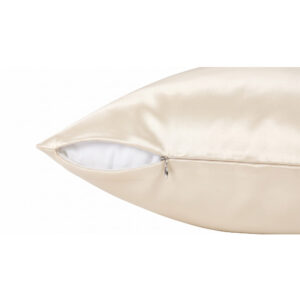
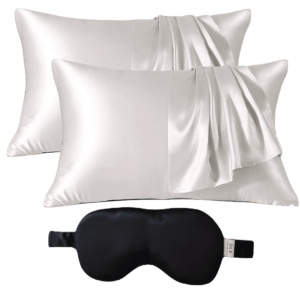
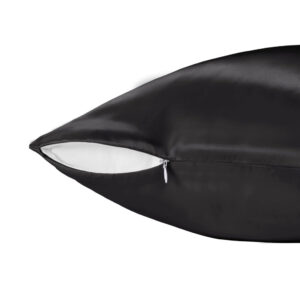
SILK SA offers pure silk pillowcases in two sizes, and together they reflect this international story.
- 45 x 70 cm is the traditional South African standard and fits the pillows most South Africans already own.
- 51 x 66 cm is the standard pillow size of the United States and Canada. Because North America is one of the largest bedding markets in the world, this size is widely produced and is increasingly seen in pillows sold outside North America. If your pillow is wider and a little shorter than the South African standard, it may well be this size.
A well-fitted case matters more with silk than with cotton. A case that is too large lets the fabric slide and bunch overnight, while one that is too small strains the seams.
How to choose the right size
- Lay your pillow flat and measure seam to seam in both directions.
- Measure the pillow as it naturally sits, without squashing it.
- Compare your measurements to 45 x 70 cm and 51 x 66 cm and choose the closer match.
- Ignore the word “standard” on your pillow’s label and go by the centimetres, since standard means something different in every country.
Frequently asked questions
Is there an international standard pillow size?
No. There is no globally agreed pillow standard. Each country has its own “standard” size, which is simply the size most commonly sold in that market.
What is the standard pillow size in South Africa?
The traditional South African standard pillow is 45 x 70 cm. Larger sizes such as 50 x 75 cm and king are also available locally.
What is the standard pillow size in the USA?
The US standard pillow is 20 x 26 inches, or about 51 x 66 cm. Queen pillows are 20 x 30 inches and king pillows are 20 x 36 inches.
Why are German pillows 80 x 80 cm?
The large square pillow grew out of Germany’s feather bedding tradition, where soft, loosely filled pillows are folded and shaped by the sleeper and also used as a back rest. Its exact historical origin is not well documented. The narrower 40 x 80 cm pillow is now becoming more popular.
Will a US standard pillowcase fit a South African pillow?
A 51 x 66 cm case is wider but shorter than a 45 x 70 cm pillow, so the fit will not be ideal. Measure your pillow and choose the case that matches its dimensions.